Campaign Kickoff Event to STOP the Menlo Park Anti-Housing Initiative

Over 100 people enthusiastically holding campaign signs that say "STOP the Menlo Park Anti-Housing Initiative"
Photo Credit: ProBonoPhoto, Ed Ebert

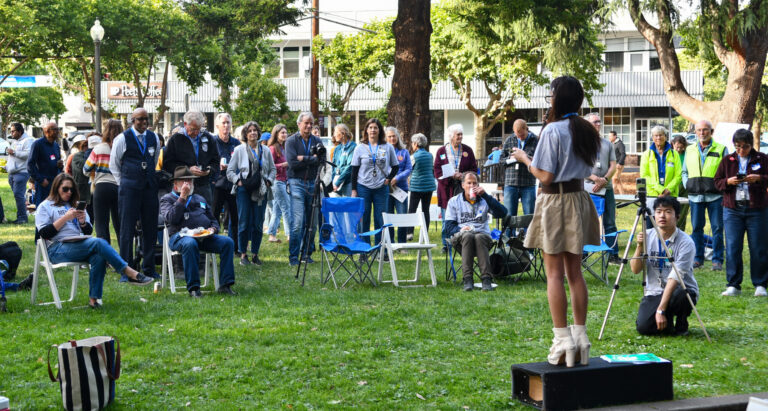
More than 100 people filled Fremont Park last Wednesday to launch the campaign to STOP the Menlo Park Anti-Housing Initiative

Enjoying burritos from Mama Coco Restaurant, interactive stations hosted by local organizations, and speeches from residents and elected leaders, the crowd learned about the intersection of housing, environmental justice, and democracy in the effort to build hundreds of new affordable homes in downtown Menlo Park.

Photo Credit: ProBonoPhoto: Ed Ebert

The event opened with Gia Pham of Housing Choices, who shared stories of folks with disabilities that illustrated the crucial role of affordable homes in allowing them to live independently in their community. Over 100 adults with intellectual disabilities currently live with aging parents in Menlo Park.

Next, Katherine Dumont shared her story as a lifelong renter and how local opposition to new apartments feels personal and fuels her commitment to this fight.

Redwood City Mayor Elmer Martínez Saballos and Burlingame City Council Member Michael Brownrigg inspired the crowd with examples of affordable homes that are transforming their downtowns into thriving spaces.

Read on for more about the event

Photo Credit: ProBonoPhoto, Ed Ebert

At the “Who Needs an Affordable Home” station, attendees learned about who might live in the new affordable homes downtown and reflected on who in their own lives might need an affordable place to live.

Photo Credit: ProBonoPhoto, Ed Ebert

The “Housing Justice” station explored the history of housing segregation, housing scarcity, and environmental injustice in our country and right here in Menlo Park.

Photo Credit: ProBonoPhoto, Ed Ebert

At the Safe Routes station, attendees learned why stopping the Anti-Housing Initiative is important to improving bike and pedestrian safety downtown and throughout Menlo Park.

Photo Credit: ProBonoPhoto, Ed Ebert

Leaders from The League of Women Voters and The ACLU of Northern California talked with folks about why they oppose the initiative, not only because of the need to build new affordable homes, but also because it threatens our democratic processes and our community’s civil rights.

Photo Credit: ProBonoPhoto, Ed Ebert

Youth United for Community Action hosted a station called “The Future is Us.” People shaping tomorrow’s policies must listen to tomorrow’s residents.  And those residents want affordable housing.

Photo Credit: ProBonoPhoto, Ed Ebert

The crowd fueled up on delicious burritos from Mama Coco Restaurant, served with Menlo Park’s zero-waste party packs (available to borrow for free!).

Local leaders like Menlo Park Mayor Betsy Nash, Vice Mayor Jennifer Wise (accompanied by second dog, Brewster), Councilmember Drew Combs, and District Director Alex Kobayashi from Senator Josh Becker’s office also joined the crowd.

Huge thanks to the incredible volunteers and professional interpreters who made this event possible! Our activators and ambassadors guided attendees through the event and connected them to the campaign. Others registered guests and checked out audio devices. And so many more behind the scenes! Our wonderful interpreters, Sol Barreto and Liliana Herrera, ensured language justice was at the heart of this event.

Thanks to ProBonoPhoto.org and photographer Ed Ebert for the beautiful photos. Check out the full gallery here

Your support is vital to keep this momentum going through November, when we will VOTE NO on the anti-housing initiative.

JOIN US to fight for Housing and Transit this November!

STOP the Menlo Park Anti-Housing Initiative!

Menlo Together is part of a broad and growing coalition working to say NO to a city ballot measure that would BLOCK the city’s plans to use three public parking lots to improve public parking, increase bike and pedestrian safety and build hundreds of new affordable homes in downtown Menlo Park.

Over 100 people enthusiastically holding campaign signs that say "STOP the Menlo Park Anti-Housing Initiative"
Photo Credit: ProBonoPhoto, Ed Ebert

Photo credit: ProBonoPhoto, Ed Ebert

Save Public Transit! Join the Connect Bay Area campaign

General Meeting Announcement

Please join us by Zoom on Sunday, March 7 from 4:00 to 5:00pm for our first General Meeting. We will:

  • Connect and hear briefly about Menlo Together’s accomplishments and how you can get involved.
  • Hear a presentation from San Mateo County Health Equity leaders, Shireen Malekafzali and Belén Seara, on the Health Impacts of Housing, Environment, and Mobility. Q&A will follow. 
  • Host optional post-meeting break-out groups to dive deeper into an upcoming activity of your choice.

Please extend this invitation to others who share our vision of a city that is integrated and diverse, multi-generational, and environmentally sustainable.

The Color of Law: Menlo Park Edition Workshops – an honest look at how we segregated our neighborhoods and how we can interrupt and reverse the pattern.

Covid-19 and the deaths of Breonna Taylor, Ahmaud Arbery, George Floyd, and the countless other Black people killed by U.S. police have once again exposed the ongoing impact of America’s long history — and present-day patterns — of racist policies and actions. These events have inspired many Menlo Park residents to learn the truth — however uncomfortable — about our city’s past, and to build a more equitable future for all. Menlo Together’s The Color of Law: Local Edition workshops have met the moment by helping local residents face our history with honesty and by offering specific opportunities to act. 

Before the racial reckoning of 2020, Richard Rothstein’s book, The Color of Law: A Forgotten History of How our Government Segregated America inspired Menlo Together to learn more about how residential segregation played out in Menlo Park. The Color of Law: Menlo Park Edition was the result of a deep dive into our local library archives. Over a hundred local residents attended this in-person workshop in 2019. In 2020, Menlo Together brought the experience to Zoom starting with Housing Leadership Council’s Housing Leadership Day and the Menlo Park City School District Speaker Series, followed by events for the Ladera DEI (Diversity, Equity and Inclusion) Committee and the San Mateo Housing Department. In total, Menlo Together’s The Color of Law: Menlo Park Edition workshops have reached almost 350 residents, with more workshops on the way.

What is the draw?

For many, the workshop’s power is in its local specificity. “It was about Menlo Park, where I live,” according to one participant. “[In the past,] learning about segregation was not about my home…” For another attendee, the most impactful part of the workshop was learning “the local history, how Belle Haven and East Palo Alto became isolated,” and “how certain [white] Menlo Park neighborhoods fled Ravenswood [school district].”

Other participants cited the impact of the personal stories of Menlo Together members Pam D. Jones and Deadra Lampkin, and member emeritus Karen Camacho, who shared how residential segregation has impacted their families. These stories made real what might have been abstract concepts before the workshop; for one participant, they “made the book come alive.”

Combined with these stories, Menlo Together’s use of the interactive tools available in Zoom made the workshop feel intimate, even with a large number of participants on an online platform. One attendee “liked most of all how everyone was encouraged to participate,” and appreciated “how anxieties about doing so were well addressed” and another “was … thrilled to find so many folks nearby who are passionate about this.”

A call to action

The Color of Law: Menlo Park Edition is not just a history lesson, it is a call to action. “I really appreciated the ways in which the workshop provided opportunities for engagement by the participants,” one participant noted. Even “more eye opening was the more recent ways in which discrimination continues to impact people of color’s access to housing or pushes them out of  their neighborhoods when there is gentrification and displacement.”

How can you engage?